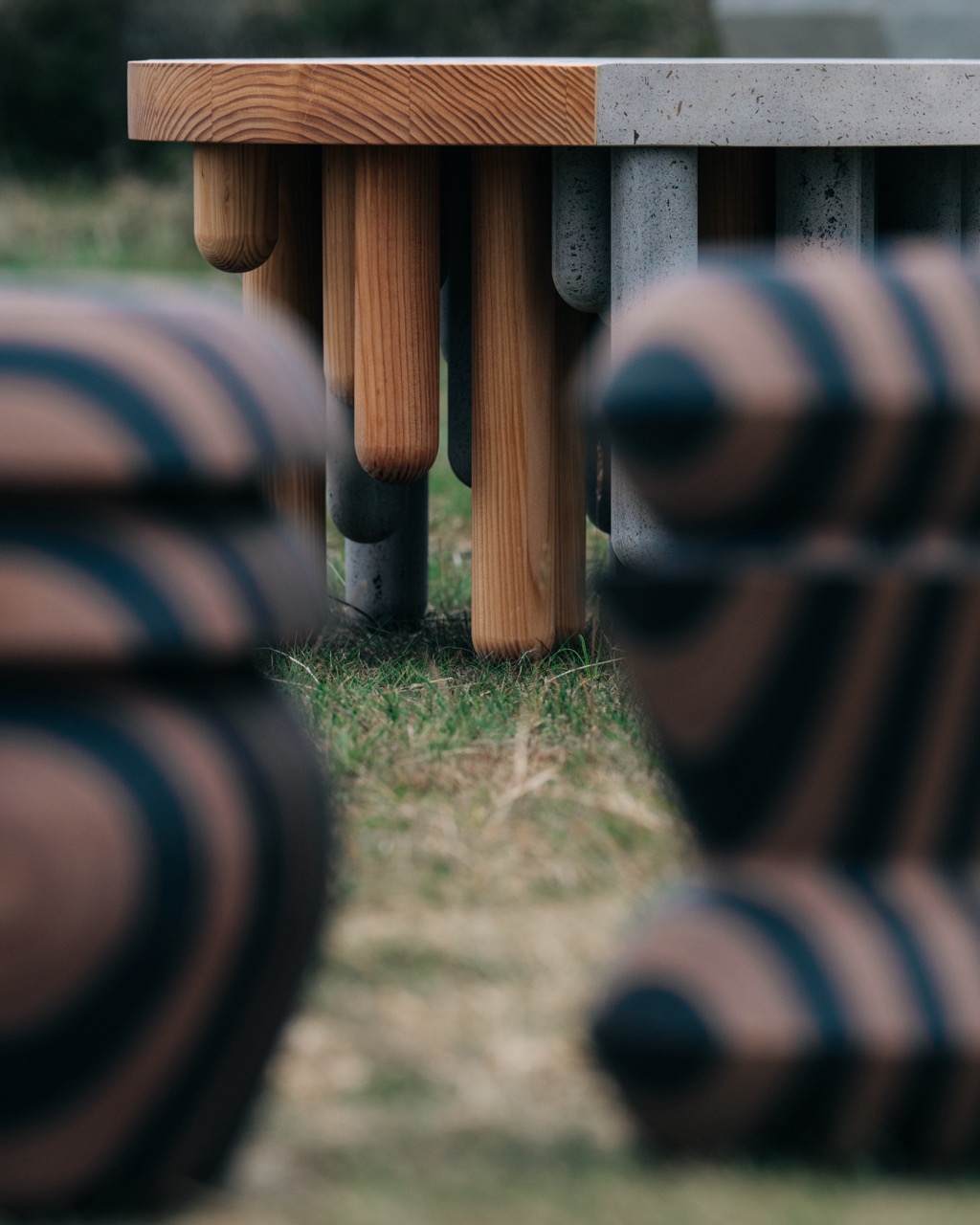
Inside the Tegners cohort shoot.
Why we shot the 2026 cohort on location at Rudolph Tegners Museum in Dronningmølle - a concrete bunker in the Danish landscape.
The Rudolph Tegners Museum sits in a stretch of moorland north of Copenhagen, in Dronningmølle. The Danish sculptor built it for himself in 1937 - a poured-concrete bunker raised over open heath, designed to hold his own bronzes and plaster casts. Today the building still does exactly that: a single, austere mass of concrete standing in the landscape, with the work it was made to house left more or less as Tegner arranged it.
It is not an obvious venue for collectible design photography.
Material against material
A contemporary studio set will flatter almost anything. Sweep, soft light, white seamless: a piece arrives as a silhouette and leaves as a hero shot. Tegners does the opposite. The walls are concrete. The floors are concrete. The light is northern and uneven. The decades-old casts in the room have their own weight, their own shadows, their own presence.
We wanted the 2026 cohort to be answerable to that. Matek as a material has a tactile, almost mineral quality - and we wanted the photographs to test it against surfaces that already carry that language. Concrete next to Matek. Bronze next to Matek. Plaster cast next to a folding screen.
What the photographs needed to do
Three things, in order:
1. Let the objects read as objects in the world, not catalogue product shots. 2. Show scale honestly. A folding screen, a side table and a coffee table need to feel like the room-sized things they are. 3. Hold the room's weight without competing with the work.
The cohort largely set its own pace. Cathrine Raben Davidsen's PARSIFAL screen took the long wall and behaved as both painting and architecture. Sophie Dries' Stria candleholders sat in the light like turned totems. Onno Adriaanse's Pyrite found its angles immediately. Willem van Hooff's Archive Cabinet wanted shadow.
What the room gave us
The Tegners environment did the editing without us asking. Pieces that needed quiet got quiet. Pieces that needed weight got weight. None of the images needed to invent a context for the work - the building had already done that, almost a century earlier.